
The ratification of the Hague Convention of 25 October 1980 on the Civil Aspects of International Child Abduction, which was signed on behalf of Turkey on 21.01.1998, was deemed appropriate by Law No. 4461 dated 03.11.1999; it was approved by the Council of Ministers Decision No. 99/13909 dated 29.12.1999 and published in the Official Gazette No. 23965 on 15.02.2000.
In accordance with Article 90/5 of the Constitution, the Convention is already part of our substantive law. Its legal framework has been established at the domestic level through the Law No. 5717 on the Legal Aspects and Scope of International Child Abduction dated 22/11/2007, which regulates the procedures and principles for ensuring the implementation of the Convention, and the Circular No. 65 dated 01/01/2006 regarding the implementation of the Hague Convention on the Civil Aspects of International Child Abduction.
This Convention contains provisions regarding the return of a child to the country of their habitual residence in cases where the child has been abducted/retained from a contracting state and taken to another.
-
- The Scope of the Act of “Child Abduction” and the One-Year Period
Due to the use of the term “child abduction,” it is possible to gain the impression that the subject of the Convention is based on criminal law; however, this international convention is a judicial assistance agreement based on the principle of interstate cooperation to ensure the return of an abducted/retained child to their habitual residence by observing the best interests of the child within the context of private international law.
What should be understood by the act of child abduction within the context of the Convention is another matter of importance. It is understood from the provisions of the Convention that for an act to fall within the scope of child abduction under the said convention, it is sufficient for the child to be taken from a contracting state where they have their habitual residence to another contracting state without the consent of the person or institution holding custody rights according to the law of the state of habitual residence.
According to Article 12 of the Convention, the necessary application must be made within one year from the date the child was abducted for the return procedure to commence. According to the relevant article, it is possible to apply even after one year has passed; however, after this stage, the application will be evaluated—as phrased in the Convention—based on whether the child has become settled in their new environment, in other words, whether the habitual residence has changed.
Whether the litigation process is included within the scope of the one-year period may be debated; it is certain that an evaluation must be made based on the concrete case. Depending on the circumstances, it may be stated that the duration of the lawsuit in the country to which the child was abducted is not conducive to granting them a new habitual residence, or that not returning a child who now has a new life network is more beneficial for them.
Regarding the fact that return shall not be avoided based on the acception that the child has settled into their environment if the application for return was made within one year of the abduction, according to the decision of the 2nd Civil Chamber of the Court of Cassation dated 23.11.2016 (E. 2016/24087, K. 2016/15092); “From the trial and the evidence collected; it is understood that the child’s habitual residence is …, the defendant mother brought the common child born in 2008 … from …, which is the habitual residence, to Turkey on 20.08.2013, the mother wrongfully retained the child, and an application was made by the defendant father within the one-year period in accordance with the provisions of the convention to ensure the return of the child to the habitual residence. The existence of a grave danger that would require the refusal of the return request, or a serious risk that the return would expose the child to physical or psychological harm or otherwise place the child in an intolerable situation (Conv. Art. 13/b), and the existence of other grounds for refusing return accepted in the convention, have not been proven. For the child’s settlement into their environment to be accepted as a ground for refusing return, the application for return must have been made after one year has passed since the child’s relocation or retention. Since the father requesting return applied within 1 year, the return cannot be avoided based on the child’s settlement into their environment. For the explained reasons, while the court should have decided on the return, the establishment of a verdict of refusal in the written form was not found to be correct”.
II. The Process of the Return of the Child
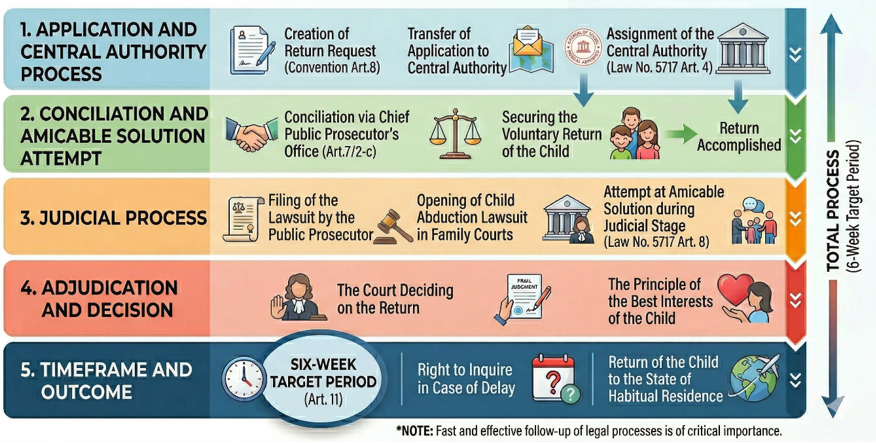 (prepared with instructions given to the Gemini AI engine)
It is useful to explain how the procedure for the return of the child to the country of habitual residence is carried out. As regulated in Articles 6 and 7 of the Convention, each contracting state designates a Central Authority responsible for directing applications for return and conducting the processes for locating and returning the child; the intermediary institution designated by Turkey is the Ministry of Justice, Directorate General for International Law and Foreign Relations[1]. Pursuant to Article 4 of Law No. 5717, this intermediary institution carries out the necessary process through the local Chief Public Prosecutor’s Offices.
This Central Authority, which exists in all contracting states, receives the request created by the party seeking the return of the child according to Article 8 of the Convention. If it is of the opinion that the child is in another contracting state, it transmits the request directly to the central authority of that state[2]; or, if the country it is affiliated with is already the country where the child is thought to have been abducted to, it initiates the necessary proceedings directly.
Initially, a conciliation process is operated through these institutions to aim for return in accordance with Article 7/2(c) of the Convention and Article 5 of Law No. 5717. If the return procedure cannot be achieved through compromise, a lawsuit for return to the habitual residence is filed in the Family Courts in line with filing of the Public Prosecutor. Article 8 of the Law regulates that an amicable solution should also be sought during the trial stage. Therefore, the Court endeavors to resolve the return of the child through conciliation, utilizing experts as well; if no result is obtained, it continues with the trial.
It must be said that an effective mechanism has been established regarding the process operated by the central authorities for the return of the child for their best interests[3]. In practice, since rapid action must be taken by nature, it is of critical importance to well-adopt the legislation applied to the process followed in the capacity of an attorney and to master the procedural system listed in the Law, in order not to waste time while the relevant authorities perform the necessary actions.
According to Article 11 of the Convention, it is essential to ensure the return of the child to the country of habitual residence within six weeks from the date of the application by following the procedural system regulated in the convention. Otherwise, the legal remedies available to the requesting country are also regulated within the scope of this article.
III. The Concept of “Habitual Residence”
As is known, the concept of “habitual residence” differs from the concept of “place of residence” in our civil law; it refers to the place where a person’s life relations are deemed to be centered, considering their factual life situation according to the concrete case.
At this point, it is of importance to realize that while determining the child’s habitual residence, factors such as the child’s age, their level of dependency on the caregiver—especially during the stage of dependency on breast milk where it is not possible to accept a habitual residence separate from the mother[4]—must be evaluated. Thus, depending on the stage of childhood, needs and the determination of habitual residence will change; it is important to understand that the act of taking a child to another country will not directly fall under child abduction within the context of the said convention.
On the other hand, at a stage where the child can establish independent life relations[5], there is no doubt that their return is necessary for their best interests if they are uprooted from the place where they intensely fulfill their life necessities and taken to another contracting state.
According to the decision of the Grand Assembly of the Civil Chambers of the Court of Cassation dated 08.03.2022 (E. 2022/145, K. 2022/276), which accepted the existence of a grave situation requiring the refusal of return due to the child’s dependency on the mother based on the child’s age: “With the filed divorce case, the parties gained the right to live separately, therefore it cannot be mentioned that the common child was brought to the country and retained through illegal means, the temporary custody right was given to the mother in harmony with the report received in the divorce case file, the child has never been separated from the mother in her life from the date of birth until this moment and has not even completed the age of three yet; it is clear that depriving a girl of this age from the accustomed motherly love and affection would expose the child to physical and psychological danger. Furthermore, as stated in the decision of resistance, considering that the child would be cared for by a third person due to the father working in case of return, the existence of a grave situation requiring the refusal of return must also be accepted”.
It should be mentioned that according to Article 4 of the Convention, the child to be returned must be under the age of 16. The 2nd Civil Chamber of the Court of Cassation, evaluating whether the child has completed the age of 16 as of the date of the decision, ruled in its decision dated 22.06.2020 (E. 2020/1690, K. 2020/3219) as follows: “…A lawsuit was filed for the return of the child named … to Germany, their habitual residence, with the writ of action dated 09.07.2014 (…) The application of the 1980 Hague Convention on the Civil Aspects of International Child Abduction ceases when the child reaches the age of sixteen (Convention Art. 4). The child Musa Koray, whose return to the country of habitual residence is requested in accordance with the Convention, was born on 24.10.2003 and has completed the age of sixteen as of the decision date, thus falling outside the scope of the convention’s application. Therefore, while the court should have decided that there is no room for a decision, the decision to accept the lawsuit was erroneous and required reversal”
ıv. Possible Grounds for the Decision to Refuse the Request for Return
Article 13/1 of the Convention
It is possible to construct decisions for the refusal of the return request—given as a requirement of the principle of the best interests of the child in accordance with certain examples mentioned above—based on Article 13/1(b) of the Convention. The relevant article is as follows:
“Notwithstanding the provisions of the preceding Article, the judicial or administrative authority of the requested State is not bound to order the return of the child if the person, institution or other body which opposes its return establishes that — a) the person, institution or other body having the care of the person of the child was not actually exercising the custody rights at the time of removal or retention, or had consented to or subsequently acquiesced in the removal or retention; or b) there is a grave risk that his or her return would expose the child to physical or psychological harm or otherwise place the child in an intolerable situation”.
Regarding the fact that examinations based on this article must be handled meticulously with the assistance of experts, according to the decision of the 2nd Civil Chamber of the Court of Cassation dated 05.10.2016 (E. 2016/10737, K. 2016/13560):
“The court reached a decision without obtaining a report from an expert such as a social worker, psychologist, or pedagogue to determine whether there is a serious risk that … born on 27.10.2007 would be exposed to physical or psychological harm or otherwise be placed in an intolerable situation if returned to Germany, their habitual residence. The court should have evaluated the matter of the child’s return by obtaining a report from an expert such as a social worker, psychologist, or pedagogue regarding whether there is a serious risk of harm, and by also taking the view of the child who has reached the maturity to express views in the case concerning them as of the date of examination. Establishing a verdict in the written form as a result of an incomplete examination without observing this direction was against the procedure and the law, requiring reversal”.
Article 13/2 of the Convention
Another issue is whether the child’s preference will be a subject of evaluation during this return process. In the second paragraph of Article 13 of the Convention, the judicial or administrative authority in the country where the child is located is granted the possibility to refuse to return the child if it finds that the child objects to being returned and has reached an age and degree of maturity at which it is appropriate to take account of its views. As this article produces effects in terms of our civil law pursuant to Article 12 of the Convention on the Rights of the Child, it is understood to be in harmony with the principled regulation of listening to the child—who is deemed to be at an age where they can form their own views in disputes regarding custody rights—and asking what their desire is to make decisions on matters concerning them. Indeed, in our civil procedure litigation, it is well known that children who are deemed to have reached the maturity to express views on matters concerning them are given the opportunity to state their opinions through Social Investigation Reports and judgments are established accordingly; it is understood that there is no obstacle to making such evaluations in cases of international child abduction as well.
However, we wish to underline that through Article 13/2 of the Convention, the abducting/retaining party gains the opportunity to manipulate the child until the return procedure is completed to avoid return[6]; courts must evaluate such situations meticulously and are under a great responsibility to make a diligent evaluation regarding which decision is truly in the best interest of the child.
According to the decision of the Grand Assembly of the Civil Chambers of the Court of Cassation dated 13.11.2013 (E. 2013/1772, K. 2013/1557), which accepted that a 14-year-old child has the ability to form views independently due to their age: “G. was born in 1999 and has the ability to form views independently from the parents as of the date of being heard. The child stated in the statement given both in Court and to the expert assigned by the Court that ‘they want to stay with the mother in Turkey and do not want to return to the father’. Since it has not been claimed or proven that the child staying with the mother is contrary to the principle of the best interests of the child, the request for return must be refused for this child as well (Convention Art. 13/2). Therefore, while the local court should have complied with the Special Chamber reversal decision pointing to the same directions regarding the child G. and adopted by the General Assembly of Civil Chambers, the resistance in the previous decision was against the procedure and the law”.
Article 20 of the Convention
Another regulation where the authority of the country to which the child was abducted/retained has the power to decide to refuse the return request is found within Article 20 of the Convention. If it is accepted that there is a violation of human rights in the requesting state of habitual residence, the refusal of the return request may come into play.
This article, which opens the door to a potentially abstract evaluation regarding uprooting the child from the life they are accustomed to, should be a subject of meticulous evaluation if it is to be applied. We wish to express our opinion that the phrase “human rights and fundamental freedoms” in the relevant article should be evaluated within the framework of the minimum standards of international human rights law, without abandoning the principle of the best interests of the child.
Article 27 of the Convention
Finally, it is useful to mention one more regulation under which a decision can be made to refuse the child’s return. This final possibility is granted to the central authority in Article 27 of the Convention in cases where it is obvious that the request is not well founded.
The central authority, which formally determines that the current dispute does not fall within the scope of the Convention, does not have the authority to conduct an examination on the merits. Examples include the child having completed the age of 16 or the requested country not being a party to the Convention[7].
This possibility granted to the requested country in the Convention shows that it is a critical matter to include all necessary information and documents in the application file to prevent a refusal decision; in this sense, the value of obtaining support from a lawyer is certain. Indeed, the information and documents that can be added to the return application have been addressed in Article 8 of the Convention in a non-numerus clausus manner.
*Atty. Sevgi Aksoy
[1] Under its new name: Directorate General for Foreign Relations and European Union Affairs.
[2] Özel, Erkan, Pürselim, Karaca; Milletlerarası Özel Hukuk, 2. Bası, On İki Levha, İstanbul, 2023, s.292.
[3] Ali Gümrah Toker, Uluslararası Çocuk Kaçırmanın Hukuki Yönlerine Dair Lahey Sözleşmesi Kapsamında Çocuğun Mutad Meskeni Kavramı, 1. Bası, Adalet Yayınevi, Ankara, 2020, s.73.
[4] Bahadır Erdem. (2011). “Türk Hukukunda Uluslararası Çocuk Kaçırma ve Uygulamaları (“Makale”)” (2015) 35 (2) MHB 147-171., s.153
[5] Aysel Çelikel/B. Bahadır Erdem, Milletlerarası Özel Hukuk, 14. Bası, Beta Basımevi, İstanbul, 2016, s. 277-278.
[6] Özel, Erkan, Pürselim, Karaca; a.g.e., s.294.
[7] Ali Gümrah Toker, a.g.e., s.107.


